


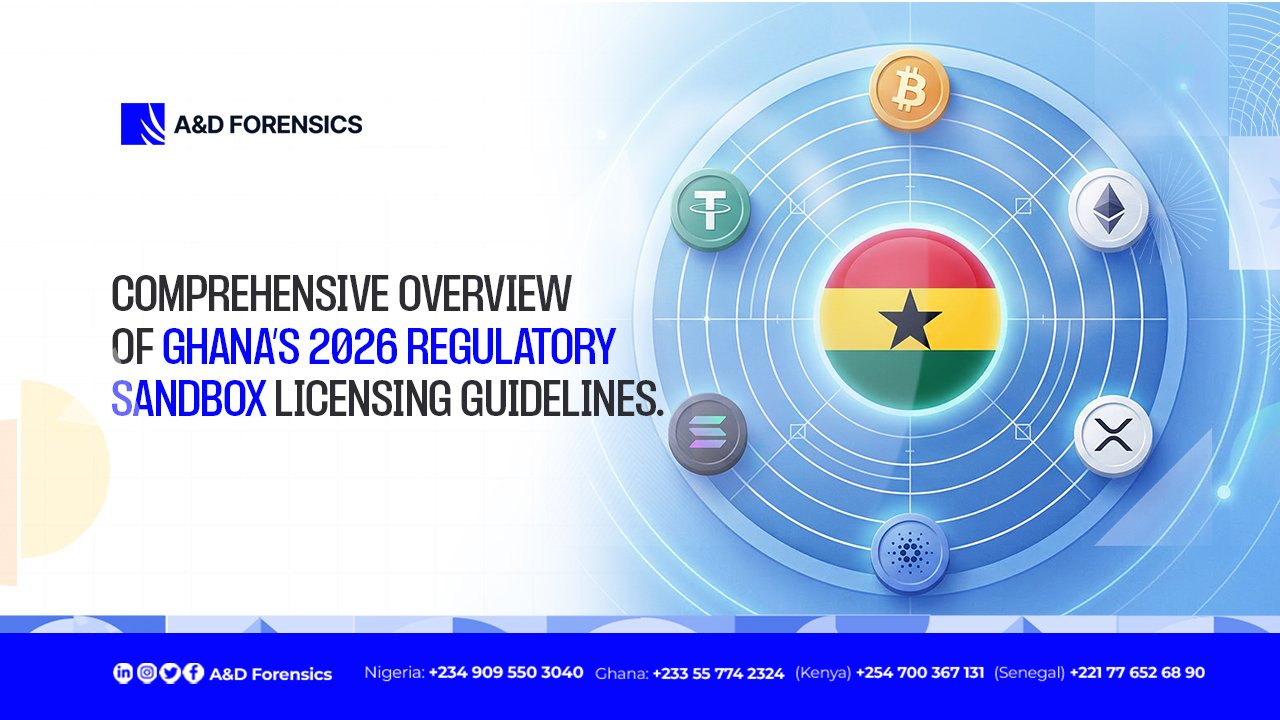

Ghana’s 2026 Regulatory Sandbox marks a significant step in the country’s evolving fintech and digital asset ecosystem. The Securities and Exchange Commission Ghana recently released the Securities Industry (Regulatory Sandbox Licensing) Guidelines 2026, following the passage of the Virtual Asset Service Providers Act (Act 1154) in December 2025, which further clarifies regulatory expectations in the digital asset space.
For fintech startups, digital asset companies, and financial institutions, Ghana’s 2026 Regulatory Sandbox provides a clearer pathway to test innovative products within a controlled and regulated environment, balancing innovation with investor protection and market integrity.
The Ghana’s 2026 Regulatory Sandbox establishes a structured environment for testing emerging financial products, particularly in digital assets, while maintaining strong regulatory oversight. It reflects Ghana’s broader ambition to balance innovation, investor protection, and financial stability.
Understanding Ghana’s 2026 Regulatory Sandbox.
At its core, Ghana’s 2026 Regulatory Sandbox is a controlled, live testing environment that allows firms to pilot innovative financial products, services, and business models under regulatory supervision.
The Securities and Exchange Commission Ghana noted that in operationalizing the Virtual Asset Service Providers Act, 2025 (Act 1154), it has finalized this sandbox framework specifically for Virtual Asset Service Providers (VASPs) to test their solutions under regulatory oversight.
The sandbox is particularly relevant where:
- Existing regulations are absent, unclear, or evolving
- New technologies (such as blockchain and tokenization) introduce novel risks
- Firms require real-world validation before full licensing
Importantly, participation in Ghana’s 2026 Regulatory Sandbox does not equate to full authorization. Licences issued within the sandbox are temporary, conditional, and limited in scope, ensuring that risks are effectively managed during the testing phase.
Ghana’s 2026 Regulatory Sandbox Duration and Transition Pathways
The regulatory sandbox operates over a 12-month period, structured to support both innovation and regulatory compliance.
- After the first six months, VASPs with market-ready products that meet all regulatory requirements may transition to full activity-based licensing or registration
- Firms that are not yet market-ready may continue testing for the remaining six months
This phased approach ensures flexibility while maintaining regulatory discipline within Ghana’s 2026 Regulatory Sandbox.
Approved Participants in the Ghana’s 2026 Regulatory Sandbox.
As part of its initial rollout, the SEC has admitted several Virtual Asset Service Providers into Ghana’s 2026 Regulatory Sandbox. These participants will help validate regulatory assumptions and test licensing frameworks in real-world conditions.
The admitted firms include:
- AFRICOIN
- BLU PENGUIN
- GOLDBOD
- HANYPAY
- HYRO EXCHANGE GH LTD
- HSB GLOBAL
- KOINKOIN
- WHITEBITS
- VAULTA
- XCHAIN
- BSYSTEM LTD
Their participation allows the SEC to validate its regulatory approach and gather practical insights needed to finalize licensing categories under the Virtual Asset Service Providers Act, 2025 (Act 1154).
Objectives of the Ghana’s 2026 Regulatory Sandbox Guidelines.
The 2026 framework positions Ghana’s Regulatory Sandbox as a tool for both innovation and oversight. Its key objectives include:
- Promoting responsible innovation in capital markets
- Ensuring investor protection and market integrity
- Supporting financial stability
- Providing a clear pathway to full licensing
The guidelines adopt a risk-based, proportionate, and technology-neutral approach, allowing flexibility depending on the nature and complexity of each innovation.
Licensing Structure and Conditions of Ghana’s 2026 Regulatory Sandbox.
Under the guidelines, a Regulatory Sandbox Licence is:
- Time-bound (typically up to 12 months)
- Restricted in scope and scale
- Subject to strict conditions and regulatory oversight
Participants must meet defined requirements, including:
- Clear testing objectives
- Risk management frameworks
- Consumer protection safeguards
- Ongoing reporting obligations
The SEC retains the authority to impose additional conditions or terminate participation if risks are not adequately managed.
Scope of Ghana’s 2026 Regulatory Sandbox Guidelines.
The sandbox framework applies broadly across the financial ecosystem, covering:
- Virtual asset services and crypto-related activities
- Tokenization and digital asset issuance
- Fintech platforms and investment technologies
- Capital market innovations and infrastructure
This wide scope ensures that Ghana’s 2026 Regulatory Sandbox remains relevant across both traditional finance and emerging digital markets.
Regulatory Significance and Market Impact of Ghana’s 2026 Regulatory Sandbox.
Ghana’s Regulatory Sandbox represents a forward-thinking regulatory approach with several implications:
- Enabling Innovation: It allows fintechs and startups to experiment safely without immediate full regulatory burden.
- Strengthening Compliance: By embedding oversight early, the sandbox ensures that innovations are built on compliance from the start.
- Informing Policy Development: Insights from sandbox participants help regulators develop data-driven policies and licensing frameworks.
- Positioning Ghana as a Regional Leader: Ghana is emerging as a leading hub for regulated digital asset innovation in Africa, adopting a “test-and-learn” regulatory model.
CONCLUSION
Ghana’s 2026 Regulatory Sandbox is more than a regulatory initiative, it is a strategic enabler of innovation within a secure and compliant framework. By providing a structured pathway for testing and eventual licensing, the 2026 guidelines position Ghana as a leading hub for regulated fintech and digital asset innovation in Africa. As the sandbox evolves, it is expected to play a critical role in shaping the future of financial regulation and digital asset adoption across the region.