



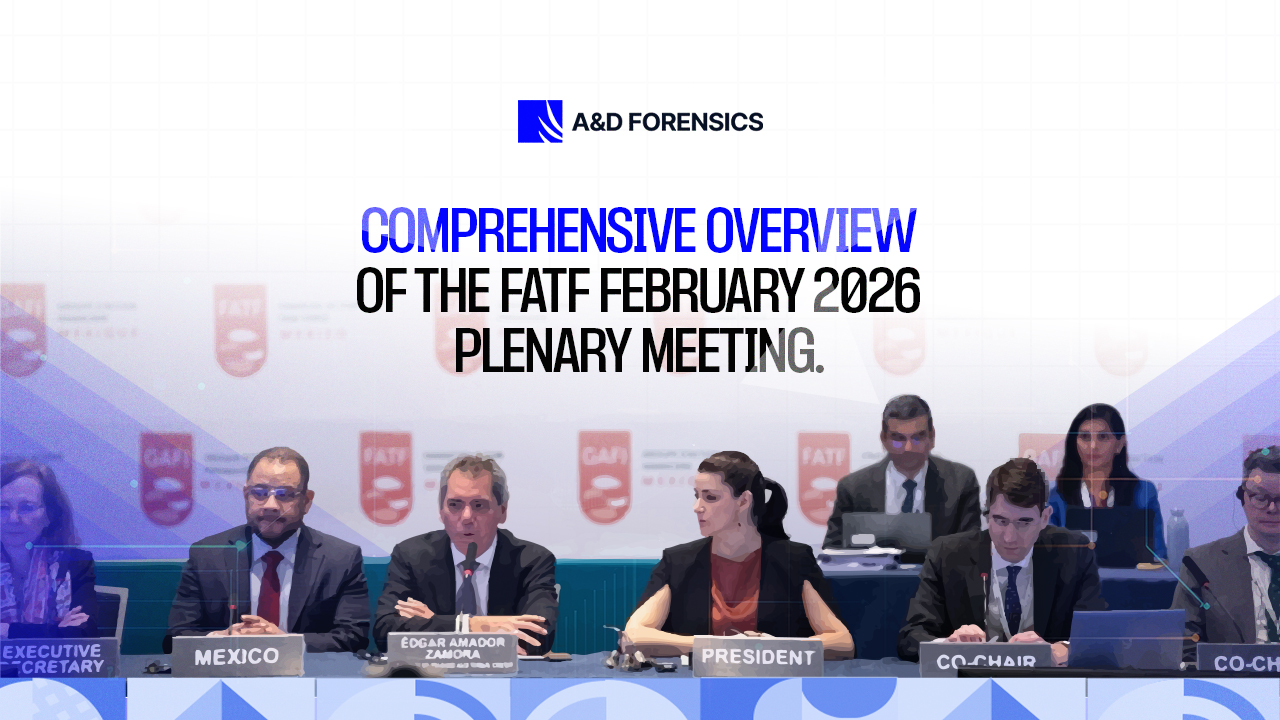

The FATF February 2026 Plenary held in Mexico city, marked the fifth Plenary meeting under the Mexican Presidency of Elisa de Anda Madrazo and concluded with decisive actions aimed at preventing fraudsters and other criminals from profiting from illicit activity.
The FATF February 2026 Plenary meeting delivered significant outcomes across global anti-money laundering, counter-terrorist financing, and counter-proliferation financing (AML/CFT/CPF) efforts. From updates on high-risk jurisdictions to strategic initiatives targeting cyber-enabled fraud and virtual assets, the FATF February 2026 Plenary reinforced FATF’s commitment to strengthening the integrity of the international financial system and ensuring that crime does not pay.
FATF February 2026 Plenary Updates on Black list and Grey list.
- Jurisdictions under Increased Monitoring (Grey List): Jurisdictions under increased monitoring are actively working with the FATF and its Global Network to address strategic deficiencies in their AML/CFT/CPF regimes. When placed on this list, a country commits to implementing a time-bound Action Plan to resolve identified weaknesses.
- Addition to the Grey List: At the FATF February 2026 Plenary, Kuwait and Papua New Guinea were added to the list of jurisdictions under increased monitoring. Both countries have committed to working closely with the FATF and relevant FATF-Style Regional Bodies (FSRBs) to address strategic deficiencies within agreed timelines.
- Removal from the Grey List: No jurisdictions were removed from increased monitoring during this Plenary.
- Jurisdictions Under Call for Action (Black List): The FATF February 2026 Plenary identifies jurisdictions with serious strategic deficiencies in their frameworks to combat money laundering, terrorist financing, and proliferation financing. These countries are subject to a Call for Action to protect the international financial system. The FATF February 2026 Plenary updated its public statementon Iran, which remains subject to a Call for Action due to outstanding strategic deficiencies.
Mutual Evaluations of Austria, Italy and Singapore.
A central feature of the FATF February 2026 Plenary was the adoption of mutual evaluation reports for:
- Austria (evaluation led by the International Monetary Fund)
- Italy.
- Singapore (joint FATF–Asia-Pacific Group evaluation)
These evaluations assess both technical compliance with the FATF Recommendations and the effectiveness of measures to combat money laundering, terrorist financing, and proliferation financing. Under the revised, more risk-based methodology, assessments now place stronger emphasis on demonstrated outcomes rather than formal compliance alone. Countries evaluated under this round will receive a time-bound Roadmap of Key Recommended Actions to strengthen effectiveness within three years. Following a global quality and consistency review, the reports are scheduled for publication between April and May 2026.
Key Outcomes of the FATF February 2026 Plenary Meeting.
- Tackling Cyber-Enabled Fraud:
The FATF February 2026 Plenary approved a major paper on cyber-enabled fraud, highlighting the rapidly escalating global fraud threat and the harm inflicted on victims. Criminals are increasingly exploiting digital innovations to scale, accelerate, and complicate fraudulent schemes. The FATF February 2026 Plenary emphasized that AML/CFT/CPF stakeholders must leverage innovative tools and stronger international cooperation to prevent fraud, recover victims’ funds, and hold perpetrators accountable.
- Virtual Assets – Offshore VASPs (oVASPs):
In response to the evolving digital asset ecosystem, the FATF February 2026 Plenary approved a report titled Understanding and Mitigating the Risk of Offshore Virtual Asset Service Providers (oVASPs). The report examines how criminals exploit regulatory gaps and inconsistent supervisory frameworks across jurisdictions. It outlines practical measures governments can adopt to strengthen oversight and close loopholes in cross-border virtual asset services.
- Stablecoins and Unhosted Wallets:
The FATF February 2026 Plenary also approved a Targeted Report on Stablecoins and Unhosted Wallets. As stablecoins continue to grow in global scale and usage, the FATF identified emerging risks, particularly where peer-to-peer transfers and unhosted wallets reduce transparency. The report provides recommendations to help jurisdictions and private-sector actors mitigate risks while supporting responsible financial innovation.
- Setting the Strategic Priorities for 2026–2028:
In preparation for the next biennium, delegates agreed on key strategic priorities to guide the FATF’s work between 2026 and 2028. The focus will be on ensuring jurisdictions keep pace with evolving threats and strengthening effectiveness in combating illicit finance. The agreed Strategic Priorities will be presented to FATF Ministers for endorsement at the upcoming Ministerial meeting in April 2026.
Appointment of New FATF Presidency 2026–2028.
During the FATF February 2026 Plenary, members appointed Mr Giles Thomson of the United Kingdom as the next President of the FATF for a fixed two-year term. Mr Thomson, who has served as Vice-President since 1 July 2025, will assume the Presidency on 1 July 2026, following the conclusion of the two-year term of Ms Elisa de Anda Madrazo. The decision followed consultations with all member delegations.
Strengthening the Global FATF Network.
The FATF February 2026 Plenary agreed on measures to increase the voice and participation of FATF-Style Regional Bodies (FSRBs) in FATF’s work. These steps aim to strengthen cohesion across the Global Network of more than 200 jurisdictions and ensure consistent implementation of AML/CFT standards worldwide.
Membership / Suspension Update:
The FATF confirmed that the suspension of the Russian Federation remains in place, consistent with its earlier public statements.
How the FATF February 2026 Plenary Updates Affect Financial Institutions and Crypto Firms.
- The outcomes of the FATF February 2026 Plenary carry important implications for regulators, banks, and crypto-asset service providers:
- Fraud as a priority risk: Institutions should strengthen fraud detection, transaction monitoring, and cross-border information sharing.
- Heightened scrutiny of offshore VASPs: Regulators and compliance teams must assess exposure to entities operating in loosely regulated jurisdictions.
- Stablecoin and wallet risk management: Enhanced due diligence on peer-to-peer transfers and unhosted wallet interactions is increasingly critical.
- Effectiveness-focused supervision: AML/CFT frameworks must demonstrate measurable results, not just policy documentation.
For crypto businesses and compliance professionals, regulatory expectations are expanding in line with technological evolution, and risk-based compliance must remain dynamic and forward-looking.
Conclusion.
The FATF February 2026 Plenary reinforced the organization’s commitment to stopping criminals from profiting from illicit activity through stronger effectiveness standards, targeted action on cyber-enabled fraud, and enhanced oversight of virtual asset risks. By expanding monitoring lists, advancing strategic initiatives, and strengthening global cooperation, the FATF continues to emphasize that the fight against money laundering, terrorist financing, and proliferation financing requires adaptability, coordination, and measurable results.
You can find previous FATF Plenary coverage from A&D Forensics here:
Co Author: Ibrahim Anuoluwapo Azeez